

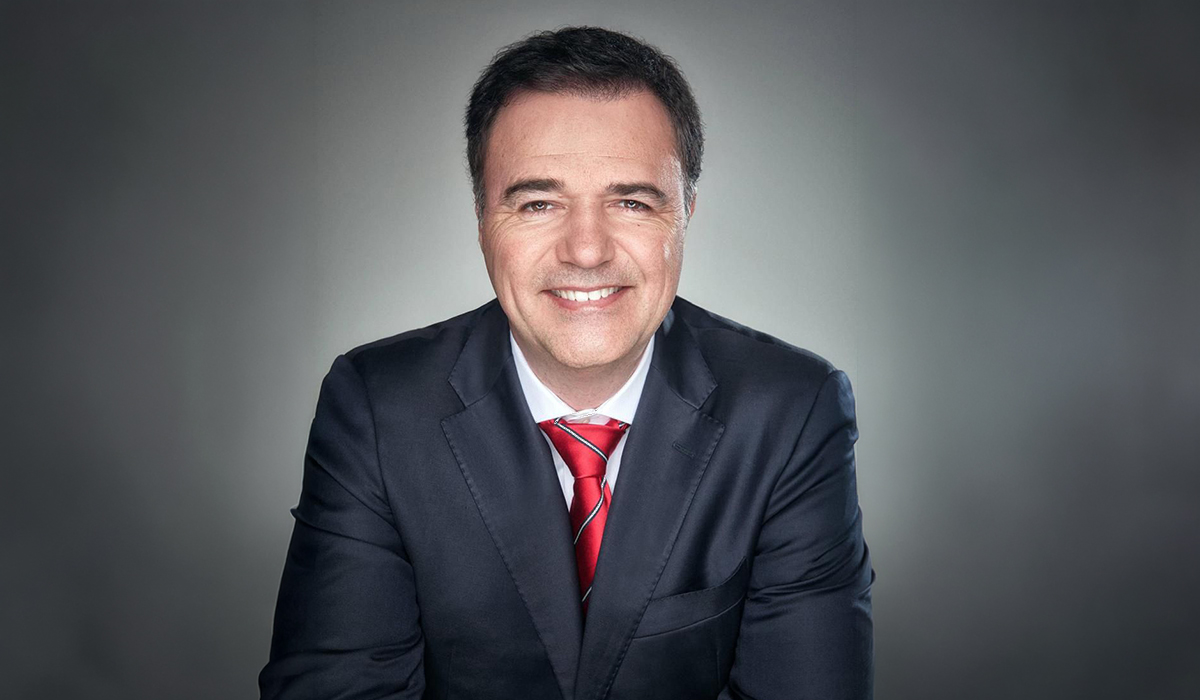
07 Jul Interview with Carlos Álvarez, CEO and President of REMED
REMED is leading one of the most ambitious infrastructure projects in the country. Can you briefly introduce the company to our readers and so they can understand how the reactivation of Guatemala’s railway fits into Guatemala’s medium and long-term economic development vision?
REMED is a U.S.-capital company — its holding company is an American firm that owns REMED Guatemala. So we are fully aligned with the current geopolitical vision of the American continent, as defined in Washington and that’s a very important point to understand. What attracted us to Guatemala? We see three key factors. Guatemala is the largest economy in Central America, it has a very young population — which is a great advantage — and it has an inter-oceanic geography: ports on both the Pacific and the Atlantic, which allows for an inter-oceanic corridor.
I believe Guatemala is experiencing a historic moment due to nearshoring — the United States’ need to invest more in manufacturing within the Americas and reduce the manufacturing that was previously done in China. This places Guatemala at a truly historic crossroads.
What challenges do we see in Guatemala? They are mainly infrastructure-related. Guatemala’s roads were not built for the current volume of goods moving through them. To give you an example: Guatemala borders Mexico and between Ciudad Hidalgo, Chiapas (Mexico) and Tecún Umán (Guatemala) at the border crossing, 1,300 trucks pass through daily. The line of trailers stretches 14 kilometers and trucks sometimes wait three or four days to cross. Once across, the average speed of a trailer on Guatemalan roads is between 5-10mph and worse when it rains. I wouldn’t call it a problem; I would call it Guatemala’s great challenge: solving its infrastructure issues so that, instead of being a transit country, it becomes a destination for investment. Guatemala is the gateway to the largest market in the world — North America — and you have the connection through the railway. The railway being built connects to Mexico’s inter-oceanic railway. The starting point of the railway in Tecún Umán, Guatemala, connecting with Ciudad Hidalgo, Mexico, means that by train, goods from Guatemala can reach Canada and goods from Canada, the United States and Mexico can travel all the way to Central America. That is why solving Guatemala’s infrastructure challenge is so critical.
Point two concerns the Rule of Law and legal certainty. Why? Because international capital does not demand perfection, it demands predictability. Give me the instruments I need to bring that international capital and ensure long-term predictability. A concrete example from our own experience: the contract we hold at REMED is a 66-year contract backed by Guatemala’s Supreme Court. That is important because this long-term concession allows foreign investors of the caliber we are bringing to Guatemala — including Siemens, UBS leading all the financial work, multilateral banks such as IDB Invest and others — to view Guatemala as an investment destination rather than a speculative one. That is what legal certainty provides.
Last October, you signed a financial mandate with UBS. What does this agreement mean in terms of international validation of the project and what opportunities does it open up for attracting more foreign investment to Guatemala?
The initial REMED project runs from Tecún Umán — the border with Mexico — to Puerto Quetzal: 146 miles and a $1 billion investment. The capital and debt raise is structured and led by UBS. Through UBS, we structured the entire financial model, incorporating multilateral banks such as IDB Invest and other significant capital partners. We are in discussions with Siemens and other very important players.
That is the first phase. The second phase runs from one of our 13 stations — in Escuintla — all the way to Puerto Barrios, Guatemala’s Atlantic port. This second phase would create a true inter-oceanic railway. This is important because it complements existing routes. As everyone knows, the Panama Canal faces significant congestion with no immediate solution and global trade continues to grow. We need to create additional inter-oceanic crossing points.
Mexico is doing great work with its inter-oceanic corridor, the Corredor Interoceánico, from Salina Cruz to Coatzacoalcos. Guatemala’s corridor complements both Panama and Mexico and the railway also connects Mexico, El Salvador and Honduras. The inter-oceanic railway thus becomes a corridor that helps relieve these bottlenecks, benefiting both Mexico’s inter-oceanic corridor and all of Central America, by eliminating the chokepoints that currently exist at border crossings and on roads that are already overwhelmed. That is actually a good problem — it means Guatemala’s economy is very healthy and growing. It is a very investment-friendly country, with 3.5% annual growth, low inflation, a stable exchange rate and a $113 billion economy. I believe many investors should be looking at Guatemala right now — because this is Guatemala’s moment.
REMED is a company of Mexican origin that chose to bet on Guatemala and establish itself there. What were the main reasons behind that decision and what concrete advantages have you found in the Guatemalan environment for developing a project of this scale?
When we started analyzing the geopolitical moment of nearshoring and the congestion issues at the Panama Canal, we also began looking at the Mexico-Guatemala connection and the problems faced by Mexican and American companies shipping goods by truck to Central America and vice versa, for Guatemalan companies exporting to the U.S., Mexico, or Canada by land or sea.
We realized there was a significant opportunity in reactivating a railway. And one of the main reasons — or two of the main reasons — was that a right-of-way already exists. A railway had already operated there and acquiring right-of-way is the hardest part of any infrastructure project, whether it’s a railway, road, oil pipeline, or gas pipeline. In the contract we signed, the full right-of-way for the existing railway was already included. However, it had been built with narrow gauge — narrower than standard. What we are doing is upgrading it to standard gauge, which is what Mexico, the United States and Canada use, so that trains can flow freely between all countries without any modifications. The trains we are focused on right now are predominantly freight. Passenger service is included, but not high-speed. We use the freight line to move passengers as well, at approximately 60 km/h. Freight accounts for 95% of operations.
Guatemala changes presidents every four years. An infrastructure project spanning 66 years must have the legal certainty of not being at risk every four years. That stability comes from the backing of Guatemala’s Supreme Court — the Constitutional Court.
There are people interested in adventure tourism and ecotourism. Could the trains also serve tourists?
Absolutely. However, high-speed trains need a long distance to reach their top speed — a 125 mph train simply can’t perform over 50 miles. We are definitely considering tourism trains. For example, the distance between Guatemala City and Atitlán, or Antigua, is quite short. A train at 35mph is perfectly adequate. The key is solving the traffic problem, which is what we’re addressing. Guatemala has what are called “sleeper cities” — communities on the outskirts of Guatemala City where people live because city living is too expensive. People wake up at 3 a.m. and spend literally three hours commuting to work.
What we want to do is place stations in those communities and run trains using existing tracks, plus new ones if needed. That way, instead of waking up at 3 a.m., people can wake up at 6 a.m. and reach Guatemala City in 20 minutes by train. We give people their quality of life back — which they deserve — and we solve the traffic problem, which is one of Guatemala’s biggest challenges.
How is the project progressing? When do you expect to finish? What is the timeline?
One of the most important elements of the project is our binational customs facility in Tecún Umán. Inside our Tecún Umán station, Mexico’s SAT (tax authority) and Guatemala’s SAT operate side by side under an agreement signed between the two countries to solve the bottleneck at the border. We are currently building a temporary depot housing both tax authorities. It will be ready in 10 months — we are 30% complete. That is the first construction phase currently underway. After that, the next phase — or running in parallel — is laying the track from that station to Puerto Quetzal: 146 miles of track, to be completed in 30 months.
Once you have the right-of-way, everything moves much more smoothly. Alongside that, working hand in hand with Ferrovías, we want to begin the northern section — connecting the two ports to create the inter-oceanic railway — which would also take around 30 months. But the two phases don’t need to be sequential; they can run simultaneously.
If you look at all the countries that have achieved development, they all have railways. In our first phase, from Tecún Umán to Puerto Quetzal, we have 13 stations. Each station is a generator of employment and development for its surrounding municipality — Pajapita, Coatepeque and so on. Each one will become a business development hub, on top of the direct employment created by our own operations. We are also working to develop the technical training programs that the railway industry will need. Since Guatemala has not had a railway for years, there are currently no people with the required skills. We are working with universities to establish technical programs: railway operators, mechanics — everything the industry needs, which is a lot. So we have direct job creation from our own operations, plus the development of entire industries that ceased to exist due to the lack of a railway. It is a very significant engine of wealth creation.
Your company bets not only on infrastructure but also on technological innovation and sustainability — a topic that matters enormously to everyone. How do these elements integrate into the development model you are driving?
On the innovation side, we are developing a system to eliminate the paperwork that currently creates bottlenecks at border crossings. Mexico already uses BUSEM — a single-window trade platform — where you register a shipment before dispatching it so that when you arrive at the border, your slot is already confirmed. We are developing and implementing the same in Guatemala, connecting Mexico’s SAT, Guatemala’s SAT and our own technology expertise to streamline all those procedures. Environmental sustainability is also very important to us. We are actively looking for the best options to reduce carbon emissions and other greenhouse gases. With the passenger train, we are exploring how to reach Antigua, how to reach Río Dulce — always with a strong focus on ecology — giving tourists the greenest possible access to these destinations.
Looking ahead, what is your vision for Guatemala over the next 10 years and what conditions do you consider essential for the country to become a regional reference and a logistics hub for investment, connectivity and sustainable development?
I see Guatemala not as a transit country or a market of 18-20 million people, but as an initial market of 150 million within 10 months, because solving the railway connection at the border automatically makes Guatemala part of a combined Mexico-Guatemala regional market.
My 10-year vision is for Guatemala, Honduras and El Salvador to initially merge into a single region — not separate countries, but a Central American region — with very compelling numbers when combined with the North American market: Mexico, the United States and Canada. I see Guatemala as a production engine and a relief valve for the Panama Canal and Mexico’s corridor. I envision factories arriving to set up in Guatemala, producing there and exporting via the Pacific, the Atlantic, or directly by rail to Mexico, the U.S. and Central America. A modern railway does not move cargo; it moves investment decisions. And capital does not flee from risk — it flees from legal uncertainty.
Sorry, the comment form is closed at this time.