

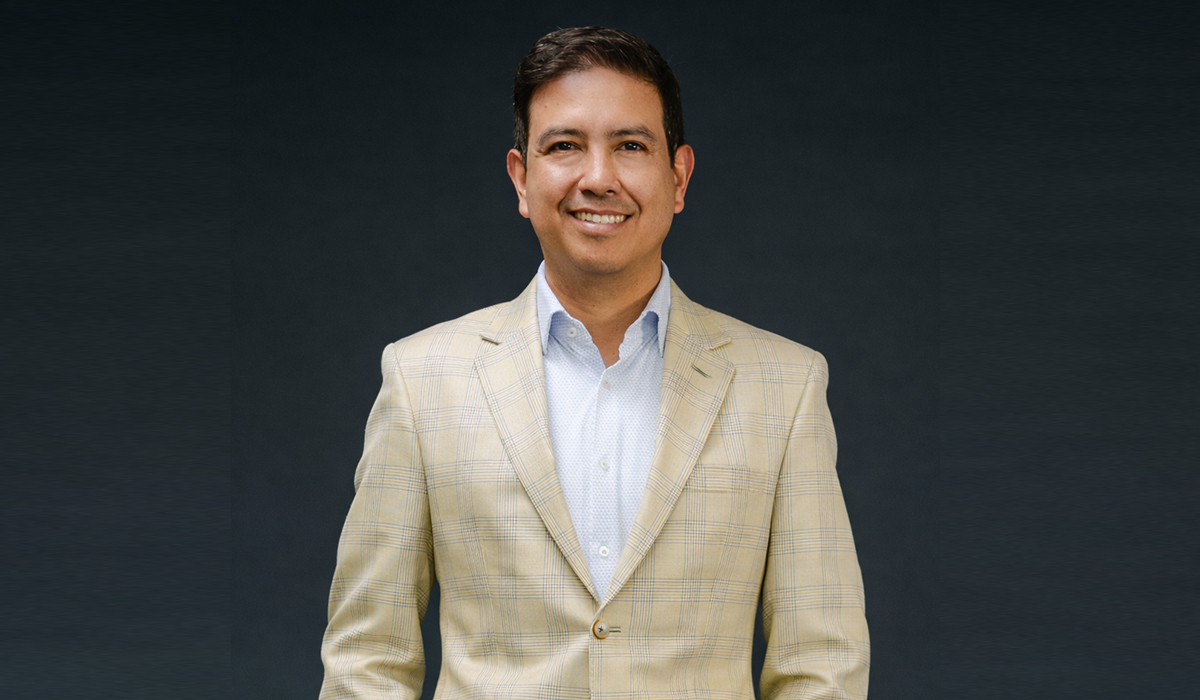
17 Feb Interview with Paulo César Parra, CEO, Energuate
Energuate is the largest electricity distributor in Guatemala and Central America by population served. How does this scale influence your strategic priorities as CEO, especially in terms of reliability, costs and grid resilience?
Being the largest distributor in Central America implies a very structural responsibility, especially because the 2.6 million customers you mention are mostly located in rural areas. These are predominantly rural, dispersed communities, with a geography that is wonderful but also complex and with climate conditions that, as is the case in Guatemala, constantly expose the country to storms and similar situations.
This forces us to develop our own solutions — our own way of addressing a reality that may not be comparable to urban or more developed markets. Therefore, our strategy is based on three key aspects. First, to be highly reliable. Second, to be very cost-efficient — which is a major challenge due to dispersion, distances and the country’s infrastructure. And third, to ensure that the grid is resilient, meaning it has the capacity to withstand disruptions.
In terms of results, over the past nine years — I have been in Guatemala for ten — we have managed to reduce outage times by half compared to what they used to be but at the same time we have also managed to grow the company, continue expanding and serve increasing demand. Achieving this makes us very proud and it has not happened by inertia, but rather thanks to strong technical discipline and sustained investment over the years. It has allowed us to contribute to the country’s development without sacrificing quality. On the contrary, improving the overall electricity service experience.
As an operator under concession until 2048, Energuate holds a key position in the country’s economic and social development. How does the company take on this responsibility and ensure accountability to regulators and communities?
That concession is not just a timeframe; for us, it represents the opportunity to materialize, through our vision, a commitment we have to the country. In other words, we are not planning the company only up to 2027, we have to think about what will happen in the coming decades.
Something very positive is that this year, 2026, marks 30 years since the Electricity Law was enacted. These have been three decades of a law that, in my view, transformed the sector and provided very strong institutional stability. What is also interesting is that it has not undergone structural changes, which provides legal certainty to companies operating in the sector: they can invest and plan with confidence. This is a very important asset for both the sector and Guatemala, even if it is not always fully recognized. But without a doubt, it is the foundation of everything that has been built so far.
Regarding our relationship with the government and communities, we are fully open to all review processes from our regulators and we fully comply with regulations, but beyond that, even though we do not have a direct regulatory obligation toward communities, we do have a real commitment. Guatemalans tend to organize themselves in smaller groups and often prefer to channel their concerns through representatives such as community councils, parish leaders, or other community leaders. We understood this and that’s why we created permanent spaces for dialogue.
Today, all our managers hold regular meetings in communities to listen directly to people. We serve around 8,000 communities and each manager is responsible for between 80 and 100. At least once every three months, we are in contact with them, actively listening. In addition, our channels remain open for people to call us or visit us. This is especially important in a country where, when there is an energy issue, users do not always distinguish whether it is a distribution, transmission, or generation problem. It may even be a failure in the regional interconnection line, from Panama to Guatemala. That is why, in many cases, more explanation is needed. Guatemala is a country that is growing and has significant infrastructure needs. And while we are investing in distribution, it is also essential that other subsectors of the electricity system do the same.
This close relationship allows us to better explain the situation to users. In the end, for many people, especially in rural areas, it does not matter where the problem originates: they say, “Energuate bills me, Energuate is responsible.” We understand that. That is why we believe our best way of ensuring accountability is to stay close, listen and explain reality as it is.
In that community engagement work you mentioned, I imagine you also talk with these 8,000 communities about environmental impacts and the sustainability processes you carry out. Could you explain how you work with them and what environmental measures you implement?
As a general principle, we have several social responsibility plans. We place a strong emphasis on education: helping people understand and explaining things clearly. We have programs that travel across the country — teams that visit communities — explaining the benefits of electricity service, but also users’ rights and responsibilities and the precautions that must be taken with the grid. This is very important because, unfortunately, accidents do sometimes occur. We have reduced them very significantly, but that has been thanks to being present on the ground, explaining the importance of electricity, its benefits and the risks and necessary precautions. We also support libraries and carry out reforestation processes and perform pruning work to manage our network: power lines require clearing the surrounding area they pass through — what we call the “corridor” of the network. We do this as a protective measure to ensure service quality, but we also try to offset that impact. For example, we organize tree-planting activities with children. We select municipalities where we have carried out the most pruning and conduct reforestation efforts there. Last year, we planted approximately 50,000 trees together with children, precisely to raise awareness about environmental impact.
Perhaps we are not as visible as other industries in this regard, because we operate in open spaces, but Guatemala is an extremely green country. That is a wonderful thing, but it is also a challenge. The care and commitment the country has toward its natural resources are very important, so everything must be done in a planned way and with the appropriate permits. This is a fundamental part of our work. We carry out pruning across approximately 3,700 to 5,200 miles of network per year, which is significant. We try to do it with the utmost care, but it is also key that the community understands it and knows why it is being done. We believe it is not just about arriving, doing the work and leaving, but also about explaining it. ensuring that people understand the reasons behind these actions.
Can you outline the structure of the company, which has majority British shareholding, and how this is the best setup for Guatemala?
Currently, yes our fund is English. Previously, we were backed by U.S. investors and now we are with Actis whose partners are English, although there are also Latin American partners, from Peru and Central America. The activities of the current majority shareholder began in September 2023. But what is important is that the management team has remained the same. We came in with a very strong work culture, based on our experience with Endesa and Enersis, with a long-term vision. When we arrived in Guatemala, there were seven expatriates and we focused on the most critical processes. From the beginning, we said: even if this is an investment fund, we are going to manage the company with a long-term vision.
That meant maintaining and even increasing investment and improving conditions for workers. For example, ten years ago, social security was not fully recognized and we corrected that. In the most recent transaction, the new shareholder said: “We love the company, but we want this management team to remain, because we like the work-plan you have put forward.” It was interesting because they asked us to continue and to explain what that long-term vision really means. In simple terms, it means that when you purchase materials, you don’t choose the cheapest option, but the one that performs best under Guatemala’s technical conditions. Within that standard, you seek efficiency, but you don’t prioritize price alone. The same applies to contractors: we implemented the highest safety standards. A few years ago, between five and eight people died each year. In the last three years, we have had only one accident. That reflects a real commitment to doing things properly.
In addition, the current shareholder has an interesting characteristic: many of its investors are family groups with a long-term vision and, with a presence in Latin America, they understand the region’s context and potential. I believe they have recognized the value of investing here without needing to relocate operations and that creates a very strong alignment between vision and execution.
It is also important to mention that the International Finance Corporation (IFC) approached us with interest in investing in infrastructure to improve quality of life in Guatemala, together with the Japan International Cooperation Agency. For two years, they carried out a due diligence process, reviewing all our operations: how we work with communities, how we resolve conflicts, how and where we invest, what materials we use, our environmental policies and whether we had all the necessary permits. After that process, they decided to grant us a loan of $175 million. They then visited us again the following year, confirmed that everything was working properly and that we had met all our commitments. When they saw that we had actually invested more than planned, they asked why we had not requested more financing. From there, we decided to move toward a bond issuance to restructure part of our debt. What is interesting is that we did not go out to seek them, they already trusted us and wanted to participate. They proposed acting as anchor investors for up to $100 million, at the market rate, demonstrating a high level of confidence.
The initial loan had a higher rate, but the bond achieved better conditions. Even they themselves were surprised by how it evolved. We went to the market for $700 million, but the issuance was oversubscribed. Of those $700 million, $100 million from IFC and we placed $600 million in the market. For those $600 million, there was demand of $3 billion i.e. five times oversubscribed. That was the level of interest the company generated.
How do you use digitalization and AIartificial intelligence in your operations, reporting and transparency?
A distribution company is characterized by carrying out a huge number of operations each year. We perform between 30 and 31 million field operations annually: going out to check a meter, delivering a bill, carrying out pruning, among many other tasks. That’s why information management is key. I would say that we don’t just have meter readers like other distributors. Traditionally, a reader goes, records the meter reading and then a bill is issued. In Europe, more advanced systems already exist, such as smart meters, but those levels of investment are not yet viable given the tariff structure in Guatemala. In our case, in addition to readers, we also have what we call “photographers.” In other words, the reader takes the reading, takes a photograph and records the surroundings. This gives us an enormous amount of information.
When we arrived in 2016, billing complaints were the main issue with customers — no one trusted the billing. We implemented a system where every reading is accompanied by a photograph. That information is processed and the system compares three data points: the number shown in the photograph, the number recorded by the reader and the number on the bill. All three must match. This creates absolute confidence. Additionally, the system measures the distance from which the photo was taken. If it was taken from a mile away and is blurry, we know the reader did not actually go to the site. We have many control mechanisms.
Another example: 40 percent of our network runs through private properties. This is because, when the State built the network in the 1990s, it prioritized the shortest distance between two points, which reduced initial costs but was not necessarily the most efficient approach in the long term. Today, this creates challenges: we need to request access permits, manage vegetation and coordinate entry. Previously, the process required multiple visits: inspection, work, verification. It was inefficient and inconvenient for property owners. Now we are developing a fleet of drones that fly over the network. These drones identify exactly where intervention is needed — where pruning is required and where it is not. This saves time, fuel and resources. We also use LIDAR technology (laser-based), which measures distances with precision. It is a significant investment, but it greatly facilitates field operations.
In Guatemala, mobility is difficult: traffic is complex and every field visit involves time and cost. That’s why, when we go out, we must be precise. We cannot go “to see what happens”; we have to go to do exactly what is needed. That precision is key to our efficiency. We have many more tools, but the central idea is this: to use technology to be more efficient, more precise and more environmentally friendly.
We are very careful with operational spending, but we invest heavily. At Energuate, we have around 600 direct employees and about 4,500 including contractors, all coordinated through very robust information systems to operate as efficiently as possible.
In the infrastructure investment and rural electrification projects you are currently undertaking, would you be interested in collaboration — either financial or in the form of technological partnerships — with U.S. companies, particularly from Miami? Is this something that could be of interest to you?
Today, what we need most — and what we are working intensively on — is infrastructure, because the country is growing significantly, including in technological terms. We are also beginning to explore more applications of artificial intelligence. For example, we have developed internal agents. If an employee does not arrive at work at 8:00 a.m. — and given that we are spread across the entire country our system can detect that they are not at the location where they were expected to be — through an internal chat, the system automatically sends a message such as: “Hi, you haven’t arrived at work today. Is everything okay?” If the employee responds that they are sick, the system advises them to see a doctor and submit a medical certificate. This information is recorded and their supervisor can also access it. This is essential for us, because we are a very large organization and we do not operate in a single physical location. We operate based on trust, but unexpected situations or accidents can occur, so we need real-time visibility.
These applications, which we initially developed for internal teams, will gradually be extended to all our field crews to monitor productivity and manage operations. We already have numerous dashboards that show how different areas are performing, including outages and other key indicators. However, supervisors sometimes have to navigate through too many dashboards, so we see a great opportunity to incorporate an additional layer where all this information is organized and interacts more directly with us. That is part of our plan for the next two years.
We have a digital transformation plan led by our chief technology officer. Another interesting application is the following: when someone goes out to perform fieldwork, they take a photograph and attach a risk assessment and description of the task. Previously, this report was reviewed manually. Now, we have uploaded all company procedures to the cloud and when the worker submits the information, it is also reviewed by an AI agent that identifies whether anything has been omitted according to the procedure. This allows the worker to correct it immediately. These are still relatively small applications, but they improve very specific aspects of our operations. The goal is to find ways to scale them.
Guatemala has many unique characteristics: basic conditions, but also fundamental needs. We aim to become a world-class company in many aspects, in order to provide the best possible service. This cannot be achieved in one, two, or three years — it is a long-term process.
The company used to be managed differently, but we are convinced that over the next 5 to 10 years we will achieve this transformation. In terms of investment, in 2016 we invested $22 million. Last year, we invested $76 million — almost 3.7 times more. For the 2026–2030 period, we plan to invest $410 million, which represents a 30 percent increase compared to the previous five-year period, during which we invested $315 million. We want to continue along this path, as long as the country keeps growing and institutional stability remains in place, meaning that commitments are honored and tariffs are defined based on proper technical studies by the National Energy Commission. With that institutional confidence, we are able to project this level of investment.
Do you have an app for customers to pay remotely or access other services?
Yes, we have several digital channels. For example, through our traditional channels, customers can choose which bank they want to use for payment. We do not require them to pay directly through us; instead, we redirect them to different financial institutions. We also provide customer service via WhatsApp. If a customer wants to request a new electricity connection, they can send a photo of the location, which includes GPS coordinates. With that information, we can install the service in approximately 12 days in rural areas — often even within a week. In addition, we have the Energuate app, the website and WhatsApp service, among other channels. In short, it is now possible to access and manage electricity services entirely through digital means.
At the company level, how competitive do you think your prices are compared to other countries in the region? Is electricity expensive in Guatemala today? How do you plan to reduce costs in the future?
I believe it is important to first understand how tariffs are structured. Tariffs depend on the design of the network. In a city, the network is built to serve concentrated demand; in rural areas, however, a much more extensive network is required. For example, we have approximately 56,000 miles of network, while a company in a capital city may have between 10,000 and 12,000 miles. That means we invest up to six times more in infrastructure, often to deliver less energy.
In a city, with 10,000–12,000 miles of network, consumption might reach around 6 terawatt-hours. In our case, with 56,000 kilometers, consumption is about 3.5 terawatt-hours. Those 3.5 terawatt-hours must sustain the entire infrastructure. That is why our goal is to continue connecting more customers: as the number of users increases on the same network, the cost per user decreases. Comparing tariffs between countries is not always appropriate, because the geographic conditions and network designs are not the same. The correct comparison would be between similar rural distribution systems.
On the other hand, the government understands this situation and provides social subsidies to optimize tariffs for certain users. For example, rural customers with consumption of up to 100 kilowatt-hours — typically in vulnerable conditions — receive support to make their bills more affordable. Those who consume more than 100 kilowatt-hours pay the full tariff.
After more than a decade in Guatemala and a regional career in the electricity sector, how have those experiences influenced your leadership and your vision for the country’s energy future?
Guatemala, like many countries in Latin America, faces real challenges in achieving its development, but it also has tremendous potential. When I arrived, I realized that unlocking that potential does not depend solely on technical expertise, investment, or infrastructure. There is a very important social component that must be understood in order to succeed.
For me, the biggest lesson has been finding the balance between modernity and sensitivity to a different reality, especially in rural areas, where the social dynamics are completely different from those in a capital city. In a city, projects tend to be more technical and “cold.” In rural areas, everything is much more close-knit: if something happens, everyone knows about it. That requires a different kind of sensitivity. I believe value is created to the extent that you are able to stay close to the communities you serve. That has undoubtedly been one of my greatest learnings.
What would be your final message to the readers of this report, both for the community in the United States and at an international level?
I think there are two audiences. To Guatemalans living in the United States, I would say that their country has strong foundations and real opportunities for development and quality of life. Today, we are seeing a growing middle class that consumes more and consumes better. This is even reflected in electricity consumption: in the past, demand was concentrated in the morning and evening; today, it is spread throughout the day. That indicates more appliances, more activity and a better quality of life. Even economic growth in the interior of the country has been higher than in the capital, which shows that development is progressing.
To investors and those who are not yet familiar with the country, I would say that Guatemala is a wonderful place. In the energy sector, they will find clear rules, strong institutions, legal stability and disciplined companies. It is a very suitable environment for developing genuine investment opportunities. And from Energuate, our commitment is to continue strengthening that confidence in the sector, because we are the ones in direct contact with the end user. If we do our job well, the entire sector benefits.
Guatemala is a treasure that has not yet been fully discovered. Perhaps one of its challenges has been not knowing how to “market itself” enough. Other countries have developed stronger promotional strategies, but Guatemala has immense intrinsic value. I’ve had the opportunity to travel to many countries and Guatemala stands out for its geography, its food, its volcanoes, its lakes and its history. The richness of Mayan culture and all the pre-Columbian development is truly fascinating. In addition, it is a country that is improving in terms of security, which is essential both institutionally and personally. I believe anyone should include Guatemala on their list of destinations. And as people used to say in Colombia, the risk is that you’ll want to stay. I’d say the same is true in Guatemala.
Sorry, the comment form is closed at this time.