

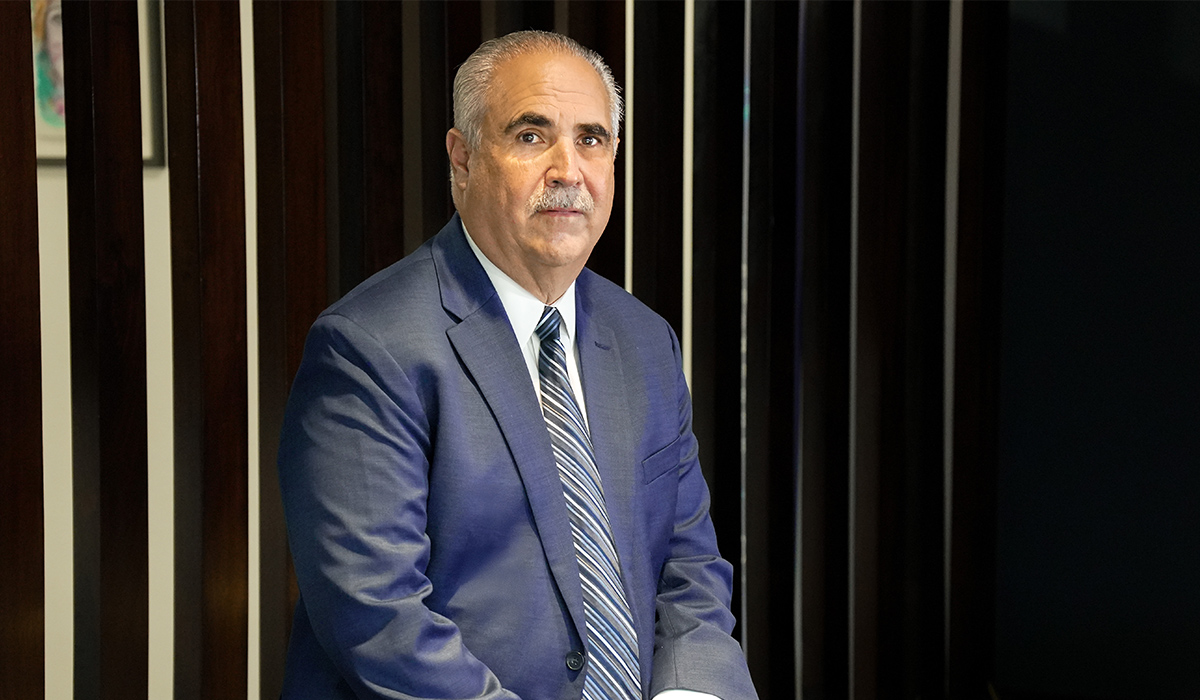
19 Feb Interview Mr. Enrique Rodríguez Mar, President of the Banking Association of Guatemala and CEO of Banco G&T Continental
Guatemala has built one of the strongest and most resilient banking systems in Central America. Financial inclusion has already reached 65% of its adult population this year, with a clear goal of reaching 90%. What are the key factors that have driven this strong progress in recent years and how Guatemala does stand out as one of the leading banking powers in the region?
I believe Guatemala stands out for having a solid banking system with great stability and sustained double-digit growth over the past two or three years, which has accompanied the country’s economic growth. Guatemala is never known for extremely high growth, but never for very low growth either — we are always growing between 3.5 per cent and four percent. In addition, during the COVID-19 pandemic, the country proved to be extremely resilient; it was the country that experienced the smallest decline in Latin America and one of the smallest in the world.
Guatemala has a very stable, consistent and disciplined macroeconomy, with one of the lowest deficits in the world and in Latin America. We have maintained very orderly macroeconomic finances and that has allowed the banking sector to enjoy the stability that modern banking requires. We depend on savers as well as on borrowers and without that stability, things become complicated. Last year — a year of extremely high global inflation — Guatemala was very resilient. Its maximum reference rate was five points below that of the United States. It was incredible and, even then, deposits never left Guatemala because there was economic activity.
Another point worth highlighting in Guatemala — one that has consolidated these two aspects, both the macroeconomy and the financial market — are our migrant heroes: remittances. Remittances are reaching $25 billion; that is almost 22–23 percent of GDP, which has greatly strengthened consumption and created strong dynamism in the private banking sector. However, this is also a warning sign. While it is true that a country like Mexico receives three times as many remittances as Guatemala, they do not even represent three percent of Mexico’s GDP. In our case, this is beginning to be a problem and a financial pressure, because it is income that comes into the country but is not produced here. That has an inflationary effect, which today has been countered through the country’s monetary policy and the exchange-rate system used by the Bank of Guatemala, which intervenes when there is an excess or shortage of dollars.
In the past two years, there has been much more excess than shortage and that generates monetary losses that must be taken into account. This brings me to the fourth point: the importance of attracting foreign investors who come to invest and produce in Guatemala. Honestly, Guatemala has it all: its geographic position, its macroeconomic stability, a strengthened and stable banking system that supports any type of investment — we have all the right conditions. Of course, we also have major challenges, such as improving our infrastructure — ports, highways, airports — and strengthening our institutions, as is the case throughout the world and in Latin America, where political institutions are worn out. Guatemala has separated politics from economics very effectively. That has allowed the economy to remain stable despite the political problems we have experienced over the last 10-12 years. The Bank of Guatemala is perhaps one of the most prestigious and institutionalized entities in the country today and Guatemalans recognize and appreciate it.
The third point is banking penetration. We have greatly increased access to banking through financial inclusion, but we still have a very large informal economy. That informal economy cannot be measured, but it is nevertheless an essential engine for the country’s overall economy. It is somewhat of a cultural issue. Great efforts have been made to bring banking services to the entire country through digitalization, mobile phones and ATMs. However, we still face the cultural challenge of a segment of society that does not want to be monitored by any authority and they know that through banking we must abide by formal regulations.
Guatemala has changed a lot. In the past, 80 percent of the economy was centralized in Guatemala City and the rest of the country was forgotten. That was one of the major criticisms: the city was very prosperous, full of buildings, but once you left the capital, that was no longer the case. Today, in the interior of the country, we see progress: shopping centers, apartment buildings and warehouse complexes. That has greatly reactivated the economy. I would say that if Guatemala grows four percent this year, the interior of the country is growing 6-7 percent, while Guatemala City is growing 1.5 percent. That means investment has been distributed throughout the country, which is very positive for improving the distribution of wealth — one of the country’s longstanding criticisms.
ABG, since its founding in 1961, is the Banking Association of Guatemala, which has consolidated itself as the main voice of the country’s private banking sector. How has the association redefined its role as spokesperson and support entity for the sector? What achievements are you most proud of?
At ABG we are proud of many things. One is that we bring together both private and non-private banks in the system. Together with the supervisory authorities, the Bank of Guatemala and ABG, we work constantly on modernizing and improving all the legislation needed to maintain a dynamic, modern banking system that is aligned with the major technological changes we are experiencing. This is not something each bank does on its own — rather, we do it in an organized, coordinated manner. That is the main purpose of ABG: to work jointly with the Superintendency of Banks and the Bank of Guatemala to maintain a permanent dialogue on how we can achieve the best international practices.
We are clear on the need for standardization and on moving forward with everything related to Basel and international norms. On the issue of money laundering, we have been the leading voice in the country, highlighting the importance of belonging to the Financial Action Task Force and Financial Action Task Force of Latin America, of being a cooperating country and of protecting capital from money-laundering crimes. We strongly believe in the importance of having this regulated with the best standards and practices.
Another important point is that through a sister company of ABG, the UCG, we manage the system’s clearinghouse. This is a major responsibility. We manage it jointly with the Bank of Guatemala, which delegates this enormous responsibility to us and we do it very well.
In Guatemala we have very modern ACH rules. I can send money from my cellphone at any time, to any bank, to any person, account to account. I can also send money from ATMs. As an industry, we are highly digitalized and this is thanks to the creation of the clearinghouse.
Another topic that strongly concerns us is cybersecurity. We have a committee that this year we will elevate to a legal entity. From there, we oversee the importance of ensuring that the entire market complies with a minimum security standard in the face of threats that affect all financial industries around the world. Since there are large, medium and small banks, we try to help everyone so that a minimum standard exists. The vulnerability of one is the vulnerability of the entire system and we are very clear on that. We have found ABG to be the forum where we can all come together. We have cost-allocation systems based on asset size and have found a way of operating that has allowed us to achieve good security standards.
The fourth area we focus on at ABG is the Banking School and the country’s financial education. We work with students from basic levels through to companies that want to learn about banking and risk. We also welcome non-regulated financial institutions, which might seem like unfair competition, but we invite them because we believe in the importance of greater financial inclusion in the country.
As I mentioned, we face a very big challenge: a large amount of cash is still used in Guatemala. Seventy percent of transactions are still in cash, due to marketplaces and the whole informal economy. That is what we must target and what we are working hard on and this can only be achieved through education and by generating trust among Guatemalans who are not yet banking users.
At ABG we work on these four areas. We do not address other market matters because we are clear that we are an entity that exists to contribute and support the development of a more modern and more competitive banking system. We are very competitive among ourselves; no one leaves space unoccupied and we all compete, but we do so with clear rules and with a supervisory framework that has proven to be successful and meticulous, allowing the solidity standards that all banks here maintain. Truly, all banks — large, medium and small — have good solvency and capital indicators, which makes our banking system credible for all Guatemalans.
Major banks such as Banco Industrial, BAC, Credomatic and G&T Continental have expanded their financing, advisory and inclusion programs to help thousands of SMEs and entrepreneurs grow. How would you describe the banking system’s commitment to promoting entrepreneurship and small and medium-sized enterprises and in what way is ABG leading this effort?
I would say it is not exclusive to those three banks. In reality, all the banks in the system see a great opportunity in serving this segment, creating new products and especially reaching out to the interior of the country, where most SMEs are concentrated. It’s impressive when you travel to the interior and see these entrepreneurs. There you find local brands, local bakeries that have built true empires in their regions. That represents major opportunities for the banks. We are all competing to see who gets there first and who serves them best.
I believe that, just like the country’s GDP growth, a large part of the banks’ growth is now being found outside the capital, where most clients are SMEs. But there is a major challenge: many SMEs still operate informally. There are entrepreneurs who handle everything in cash. They have a bank account, but one under their personal name; they deposit their business sales there, withdraw the money the next day and do not keep formal accounting. There is still reluctance to take part in the bureaucratic process required for structured accounting and paying taxes. Guatemala has one of the lowest tax collection rates in Latin America — around 13-14 percent, far below countries that reach 30 percent — so it is not an issue of high taxes. Even so, there is a cultural factor in which many business owners avoid formality, not because the money is illicit; simply, in the interior everything is handled in cash: sales of cars, livestock, vegetables, textiles. That is the major challenge. Without a doubt, both the public and private sectors are analyzing what other countries facing the same problem have done, to see how we can move toward greater formalization.
Being formal also brings benefits, but many people are unaware of that. That is what we aim to communicate through the Banking School. For example, it is difficult for them to understand that an informal business owner pays VAT on everything they purchase but does not recover it. If they were to record their purchases, they could reclaim that VAT. But since they do not know this, they miss out on that benefit. This is part of the financial education we must continue to promote.
With the Guatemala No Se Detiene plan, which aims to attract $2.1 billion in FDI by 2032, and considering that the United States remains a major investor in the country, how is the ABG, together with the country’s main banks, positioning Guatemala as an ideal destination for international — especially U.S. — capital?
We have been working within the technical committee alongside the government, the Bank of Guatemala and the Superintendency of Banks. What we are seeking is to achieve a well-known investment grade. Guatemala has been working toward that; in its macroeconomy and in all economic aspects we have the conditions to obtain it. We may have some shortcomings in social indicators but for example, Guatemala’s bonds already have the same price as those of a country with investment grade. That is what we have been trying to promote and communicate to different actors in society: the importance that attaining investment grade would have for Guatemala. We believe we can achieve it, although efforts must be made to improve infrastructure somewhat, especially ports and airports. These require multimillion-dollar investments and we hope that U.S. companies — or companies from anywhere in the world — can come to invest in Guatemala, because there is a significant deficit and our own resources are not enough to do it alone. Here, no amount of money is sufficient to cover the need we have to develop the necessary infrastructure to become a country that investors truly see as a reliable destination.
Another gap we have is investment in electric power. Five years ago, Guatemala was an energy exporter. Today, with the growth we have experienced, it has become necessary to expand the electric grid — something that has become increasingly complicated due to environmental requirements and bureaucracy. Although Guatemala has a fairly clean energy matrix, with a lot of hydroelectric power, almost no new hydroelectric plants are being built anymore. Now we are moving forward in solar and wind energy and exploring natural gas a bit, but we still have many needs in this area.
As far as I am concerned as the CEOr of Banco G&T Continental — and I know many of my colleagues share this view — we open our doors to all foreign investors who have come to learn about Guatemala. The only thing that can truly consolidate the country, strengthen its economy and improve Guatemalans’ quality of life is foreign investment. Local and domestic investment does exist — Guatemala has a successful entrepreneurial class that believes in the country and reinvests in it — but we also need foreign investors. Guatemala has very favorable characteristics, such as its geographic location, its neighboring countries and the fact that it is the largest economy in Central America. In addition, we have strong artisanal skills and microclimates that are ideal for those who wish to cultivate. Hopefully all of this can be leveraged and that will be Guatemala’s near future..
As CEOr, what information can you give us about the services this bank offers in particular and how it can be attractive for any potential investor from the United States? Why should someone choose to bank with your bank?
We are the third-largest bank in the Guatemalan market, a financial group that is celebrating 75 years of existence in Guatemala. We operate exclusively in the country and focus on being a general bank, covering basically all the areas that banking allows. This does not mean that we are in every market segment: there are very specialized areas, such as microfinance, which we serve by supporting microfinance institutions, but not directly. We also support cooperatives, although we do not operate in that segment ourselves either.
In terms of composition, we are a bank that is 60 percent corporate and 40 percent consumer. This percentage has been shifting; eight years ago we were approximately 80 percent corporate and only 20 percent consumer. We believe that in consumer banking — personal banking and SME banking — lie the major opportunities for the future. Corporate banking, while relevant, is more restrictive and its margins are increasingly reduced, whereas consumer banking has shown that it allows for the development of better products, because this is where the greatest demand exists, both from individuals and SMEs.
That is why we have tried to evolve with new products. We have taken an interest in covering different regions of the country and we are very enthusiastic because we are seeing strong growth outside of Guatemala City, in areas where truly significant development is taking place.
At the digital level, have you used any specific banking app to reach citizens?
Today in Guatemala, that is everyone’s race. Currently, 80 percent of the bank’s transactions are digital. Before the pandemic, it was perhaps 30 percent, but the pandemic moved the entire industry, not just G&T. We have done our part and I believe we have one of the highest digitalization indicators in the market. We already have digital credit and digital opening of checking and savings accounts, where people can basically serve themselves. Eighty percent of our products can be obtained from a cell phone. We are transforming our branches into business offices, where people can start a relationship, but increasingly it is we who must go out and look for the client, because fewer and fewer people are coming in, especially young people, given the demographic structure we have.
The entire system has moved toward digitalization and we believe we will continue growing in that direction. We are currently also working on electronic wallets, just like all banks. We’ll see what emerges, since we have a very agile and dynamic clearinghouse that operates 24/7. Wallets have struggled to take off in Guatemala, unlike in countries such as Panama, Peru or Colombia, because here, if you have a bank account, you can operate and make payments to anyone else with an account in any bank. And if they don’t have an account, you can send money to their phone number and they can withdraw it at an ATM. This has addressed the need that digital wallets met in other countries.
In Guatemala, that need is already solved through the clearinghouse. We’ll see if any truly successful wallet emerges and manages to stand out, but personally I see it as difficult because we are already meeting those needs efficiently.
What would be your final message as president of the Banking Association and as CEO of Banco G&T?
I would like to take this opportunity to invite anyone who does not know or has not read about Guatemala to do so, because it is worth it. We are a truly beautiful country. We have beautiful natural resources, the people are very warm; Guatemalans are affectionate and, by nature, good people.
In addition, we have good conditions for investment. We have demonstrated democratic maturity that, although not very old, already totals more than 30-35 years of living in a democracy. It is still recent, but we firmly believe in private property at economic levels. In Guatemala, people take care of their property and their land, both large and small owners.
It is a country that has promoted entrepreneurship and I would say that what we Guatemalans want is to be allowed to work in peace. We would like more people to come and invest, because here there is the willingness and the human resources to grow any capital or enterprise. We are a country with many excellent qualities.
Sorry, the comment form is closed at this time.